
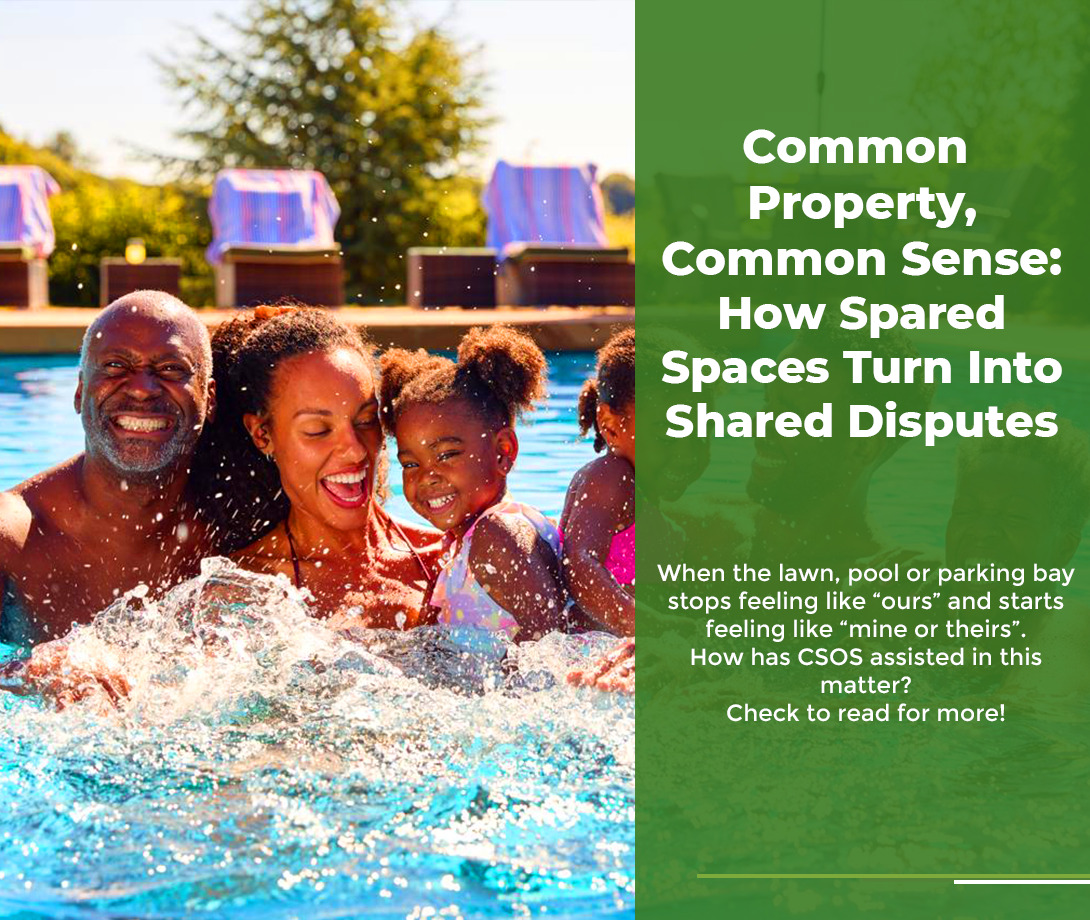
Common Property, Common Sense
When the lawn, pool, or parking bay stops feeling like “ours” and starts feeling like “mine vs. theirs.”
By CSOSlive Digest Editorial Team
(6–7 minute read)
The Pool That Divided the People
At Willowbrook Heights, the community pool was meant to bring people together.
Kids learned to swim there. Families cooled off in summer. Neighbours waved over sunscreen and towels.
Then came a birthday party.
Mr. Dlamini hosted a small celebration for his daughter. Balloons, cupcakes, and cheerful music filled the pool area.
But not everyone liked the splash.
From her balcony above, Mrs. van der Merwe frowned. She phoned security and complained:
“They are treating the pool like it’s their private party spot!”
Soon security arrived. Voices rose. Someone pulled out a phone and recorded the argument. The video landed in the complex WhatsApp group.
Within hours, the community split into two groups:
Team Relaxation — “Let children enjoy the pool!”
Team Regulation — “Rules are rules! Follow them!”
By Monday morning, accusations flooded the trustees’ inbox:
- “Noise and nuisance!”
- “Harassment and intimidation!”
- “Discrimination and unfair treatment!”
What started as a splash turned into a legal wave… all the way to the Community Schemes Ombud Service (CSOS).
The Case: What Does “Common” Really Mean?
Case Reference: CSOS/PTA/1210/25 (fictionalised but based on real patterns)
The Complaint
Mr. Dlamini said he was unfairly treated, claiming other residents used the pool without booking and without punishment.
The Defence
The trustees said he didn’t book the facility and that the pool rules limited gatherings to six guests.
The Ruling
The CSOS adjudicator sided partly with the complainant. Not because rules were wrong—but because trustees enforced them inconsistently.
“Common property belongs to all members — but it must be used fairly, transparently, and consistently.”
CSOS Orders
- Pool policy must be rewritten for clarity.
- All rules must be posted online and on noticeboards.
- Trustees must receive training on fair and equal enforcement.
The Human Side: When Belonging Becomes Battle
Shared property is emotional.
People think:
“I pay levies, so part of this is mine.”
But in law, everyone owns it together.
And when one person uses more, others feel like they have less—even if nothing was taken.
This is called the scarcity illusion.
It turns lawns into battlefields, parking bays into wars, and pool parties into legal cases.
A trustee reflected:
“It’s never about the pool. It’s about people wanting fairness they can see.”
And that’s the secret to most CSOS rulings:
People accept rules more easily when they understand them clearly.
Lessons from the CSOS Ruling
| Lesson | What It Means |
| 1. Transparency Is Key | Publish rules clearly to prevent confusion and gossip. |
| 2. Equal Access Needs Management | Booking systems and clear limits make use fair. |
| 3. Tone Changes Everything | Respectful communication builds compliance. |
| 4. Common Sense = Governance Skill | Rules need empathy, not just enforcement. |
Where “Common” Becomes Conflict
| Area | % of Common Property Disputes (2024) | Common Fight |
| Parking Bays | 38% | Who parks where, visitor misuse |
| Pools & Recreation | 22% | Noise, guests, bookings |
| Gardens & Lawns | 18% | Who uses vs. who maintains |
| Lifts & Lobbies | 12% | Cleaning, damage, vandalism |
| Laundry Areas | 10% | Scheduling & cleanliness |
CSOS Insight
Most disputes don’t come from bad people.
They come from unclear rules.
“When rules are clear, behaviour follows. When rules are vague, conflict fills the space.”
What This Means for You
Trustees
- Make policies for all shared spaces
- Publish rules everywhere (online + noticeboards)
- Lead by example — follow the very rules you enforce
Residents
- Remember: “common” means shared, not “mine”
- Clean up, follow time limits, respect bookings
- Don’t attack trustees — attack confusion with questions
Managing Agents
- Use digital booking systems (QR codes or online)
- Train trustees in communication and conflict skills
- Review rules every year for fairness and legality
Final Reflection: Harmony Is a Shared Habit
Common property is more than pools and parking lots.
It is the place where strangers learn to be neighbours.
Rules are not fences.
They are bridges that show how we share, not how we fight.
The best sign of a healthy scheme isn’t perfect lawns or quiet pools.
It’s a community where respect is shared property too.
“Shared space becomes shared peace only when empathy joins the title deed.”
CSOS Digest Takeaway
| Principle | Description |
| Transparency | Publish and explain all rules openly |
| Governance | Enforce rules consistently, without favour |
| Empathy | Understand feelings, not just regulations |
| Dialogue | Talk early — prevent conflict, don’t manage it |