
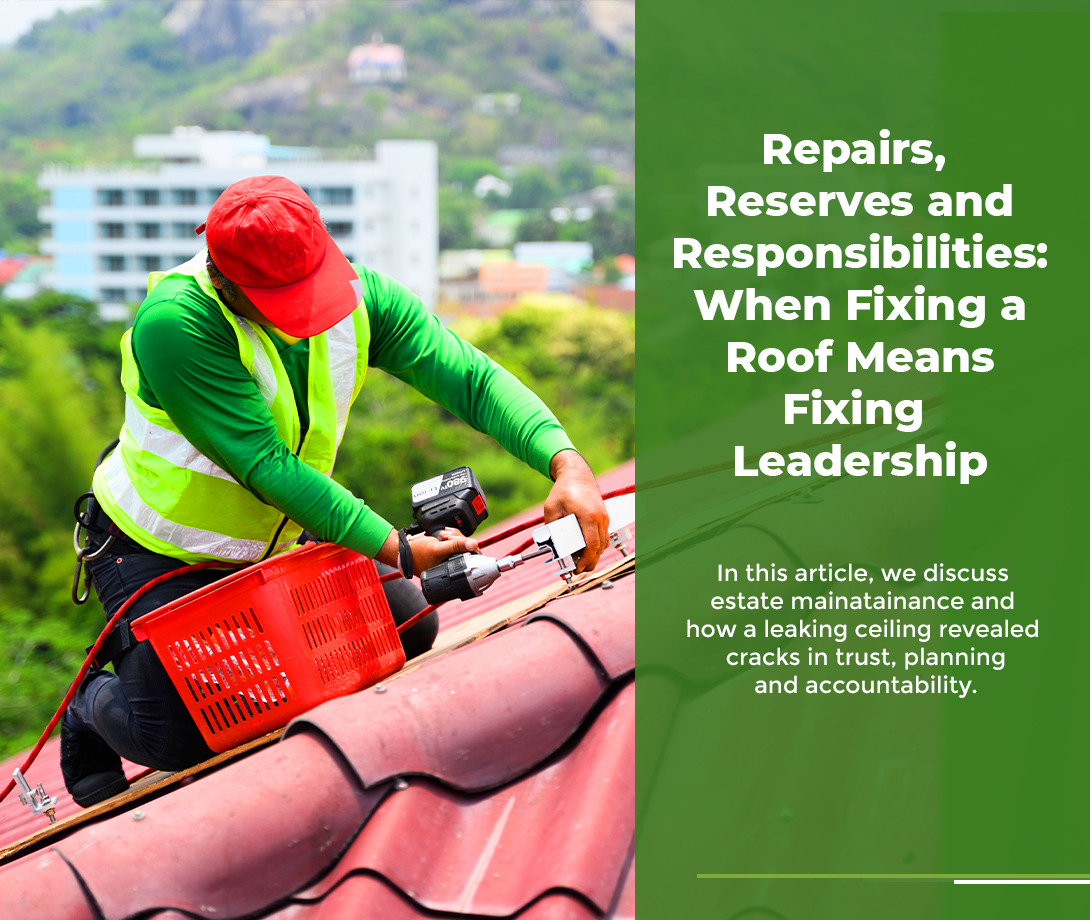
When Fixing a Roof Means Fixing Leadership
How a leaking ceiling revealed cracks in trust, planning, and accountability.
CSOSlive Digest Editorial Team
The Story: The Roof That Broke the Relationship
At Hillside Court in Johannesburg, the first sign of trouble didn’t start with anger or arguments.
It started with a brown stain on a ceiling in Unit 7.
Mr. Mokoena noticed it during the rainy season.
He emailed the managing agent.
Then he waited.
Weeks passed.
Then months.
The stain grew darker… until the plaster finally fell.
Still, nobody came to fix it.
No update.
No timeline.
No explanation.
Feeling ignored, he withheld part of his levy payment.
“Fix the roof first, then I’ll pay,” he wrote.
The trustees responded with a legal letter for arrears.
By the time the case reached the Community Schemes Ombud Service (CSOS), the real problem wasn’t the leak anymore.
“It was never just about water,” Mr. Mokoena said. “It was about being ignored.”
The Case at CSOS: When Maintenance Becomes Mismanagement
Case Reference: CSOS/JHB/1378/25 (fictionalised composite)
The Complaint
Mr. Mokoena said the trustees failed their legal duty to maintain the building, causing damage to his home.
The Defence
Trustees said there wasn’t enough money in the reserve fund and that other urgent repairs had already stretched the budget.
The Ruling
CSOS ruled in favour of Mr. Mokoena, stating:
“The duty to maintain is absolute, not optional.”
Shortage of funds is not a valid excuse for ignoring required repairs.
CSOS Orders
- Roof repairs must be done immediately by a qualified contractor.
- The 10-year Maintenance, Repair and Replacement Plan (MRRP) must be reviewed in 30 days.
- Updated reserve forecasts must be shared with all owners.
- Mr. Mokoena must be reimbursed for verified damages.
The Human Side: When Maintenance Becomes Meaning
Maintenance problems start small — a stain, a crack, a loose tile — but when ignored, they damage more than buildings.
They damage trust.
To owners, every delay feels like disrespect.
To trustees, every complaint feels like blame.
But the real issue isn’t the repair…
It’s the relationship.
A CSOS adjudicator summed it up well:
“Owners don’t expect perfection. They expect presence.”
People don’t lose faith in walls and roofs.
They lose faith in leaders who don’t communicate.
A leak doesn’t just damage a ceiling.
It damages confidence.
Lessons from the CSOS Ruling
| Lesson | What It Means |
| 1. Maintenance Is a Legal Duty | Trustees must fix common property. No excuses. |
| 2. Reserve Funds Are Protection | They exist to prevent predictable repairs from becoming emergencies. |
| 3. Builds Patience | If owners know the plan, they tolerate delays. |
| 4. Delayed Repairs Cost More | Costs increase — and trust disappears even faster. |
The Bigger Picture — The Maintenance Crisis
| Indicator (2024) | Insight |
| Schemes with Updated MRRPs | 46% — many are falling behind |
| CSOS Cases Involving Maintenance | 24% — rising each year |
| Average Reserve Fund Ratio | 0.18 — below the recommended 0.25 |
| Cost Increase from Delayed Repairs | +38% after 3 years |
Expert Insight:
“Every leak tells a leadership story. A proactive board fixes it; a reactive one explains it.”
What This Means for You
Trustees
- Review the MRRP every year and share updates.
- Treat reserve funds as ring-fenced, not emergency cash.
- Plan ahead — don’t react late.
Owners
- Levies are not optional — they protect your investment.
- Ask for updates respectfully and request financial visibility.
- Use CSOS only when communication breaks down.
Managing Agents
- Use digital tools to track repairs and timelines.
- Help trustees get quotes and monitor contractors properly.
- Host “maintenance walks” during the year to reinforce shared responsibility.
Final Reflection: From Repair to Renewal
A community scheme is more than a building.
It’s a shared promise to take care of what we own together.
Cracks in walls can be seen.
Cracks in communication cannot.
Both must be repaired.
CSOS rulings show that failed maintenance is rarely a construction problem.
It is a communication problem.
“Maintenance is not just about fixing buildings — it’s about maintaining trust.”
The future of strong communities is not more rules.
It is more responsiveness.
CSOS Digest Takeaway
| Principle | Description |
| Transparency | Share maintenance plans and finances openly. |
| Governance | Treat reserve funds as mandatory protection. |
| Empathy | Communicate early — silence grows resentment. |
| Accountability | Good leadership = timely repairs. |
Next in Series
“The AGM Aftermath: Why Meetings Make or Break Communities.”
About CSOSlive Digest
CSOSlive Digest is an independent commentary and storytelling platform focused on the Community Scheme Ombud Service (CSOS) and shared living governance across South Africa. We uncover the lessons, the conflicts, and the human stories behind community living — helping trustees, homeowners, and managing agents build more transparent, harmonious communities.